top of page



Anchor 1


Why is it better to turn to me for 3D printing?
-
Any commercially available 3D filament.
-
No minimum order quantity.
-
Quality control: dimensional accuracy, shrinkage, and alignment.
-
Material certificates available upon request.
-
Rapid cost estimation.
-
Flexible pricing tailored to the client.
-
Post-processing services (sanding, painting, dyeing, etc.).
-
Design and development of enclosures, nozzles, bushings, covers, holders, and cases—customized to your specifications and branding.
-
Always available for communication.
What materials can I use for printing?
PLA, PLA-CF, PLA-GF
Any parts, structures, or objects that do not require high load-bearing capacity and are not exposed to temperatures exceeding 50°C. This includes toys, sculptures, educational aids, architectural models, replicas, prototypes, decorative items, recreational structures, etc.
PETG, PETG-CF, PETG-GF
A stronger material capable of withstanding temperatures up to 65–70°C. It is suitable for manufacturing mounting brackets, internal components, electronic device enclosures, adapters for household appliances, and similar items.
ASA, ASA-CF, ASA-GF
The most widely used material in consumer goods manufacturing, industry, and engineering applications—essentially an improved version of ABS. It withstands operating temperatures up to 95–105°C. It is an excellent choice for electronics enclosures, automotive components, as well as objects or parts intended for outdoor use—whether under direct sunlight or in cold conditions. It is ideally suited for housings, connectors, adapters, fasteners, and structural parts.
PPS-CF
(Polyphenylene Sulfide reinforced with Carbon Fiber) is a high-performance 3D printing filament, often from brands like Bambu Lab or Polymaker, designed for extreme durability, chemical resistance, and high heat tolerance. It acts as a metal replacement for functional, rigid parts in aerospace and electronics.
PA12-CF
A variety of Nylon optimized specifically for 3D printing. It is an extremely strong and wear-resistant material capable of withstanding operating temperatures up to 150–170°C. This material is suitable for manufacturing gears, heavy-duty housings, under-the-hood automotive parts, bicycle and motorcycle components, aerospace parts, as well as any other components, structures, or objects where reliability and durability are of paramount importance.
PA6-CF
A variety of Nylon developed for the most demanding applications. It withstands operating temperatures of up to 209°C.
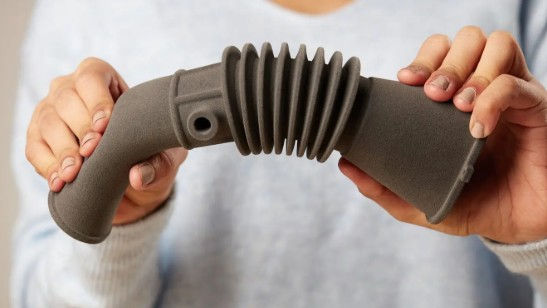
TPU 95A
An elastic, flexible plastic with a consistency resembling hard rubber. It can be used to print dampers, flexible housings, protective covers, nozzles, adapters, toys, and any other items requiring a material with rubber-like properties.
NOTE: Items printed on a 3D printer will not have the same smooth appearance as items made by the expensive casting method. 3D printing allows you to make an item, part, object in a single copy or in small batches, in a short time. But you need to take into account all the features of 3D printing: not a perfectly smooth surface, "echo", lines. In general, all this does not affect the functionality of the part, but it will be reflected in the appearance. The speed of production and cost outweigh.




1/1
bottom of page